
Landed Cost for Miami Importers: A 2026 Calculation Guide
Landed cost is the total cost of getting a product from the supplier’s door to your warehouse shelf, ready to sell. It is the unit price plus freight, insurance, duties, taxes, port and terminal charges, drayage, handling, and inventory carrying cost. Importers who price off the supplier invoice alone routinely underestimate true cost by 20–40% on ocean freight through PortMiami.
The six components of landed cost
1. Product cost
The supplier’s invoice price, adjusted for any assists, royalties, or tooling you paid for separately. Note that assists are dutiable even when they are invoiced separately from the goods.
2. International freight and insurance
Ocean or air freight plus the surcharges that ride on top — BAF, GRI, peak season, and congestion fees. These move independently of your base rate; our guide to ocean freight surcharges breaks down which ones are negotiable.
3. Duties, taxes, and fees
Normal duty by HTS classification, plus Merchandise Processing Fee and Harbor Maintenance Fee, plus any trade remedy duties. Section 232, Section 301, and antidumping and countervailing duties can dwarf the base rate, so check coverage before you model the cost.
4. Port, terminal, and customs charges
Terminal handling, chassis, pier pass, customs brokerage fees, ISF filing, and exam fees when CBP pulls the container. Exams are a real budget line, not an exception — see CBP container exams at PortMiami.
5. Inland transport and handling
Drayage from the terminal, devanning, palletizing, storage, and outbound distribution. Free time is short and demurrage accrues quickly; our guide to demurrage and detention covers the clock.
6. Carrying and risk cost
Capital tied up in inventory in transit and in storage, plus shrinkage, damage, and obsolescence. On long ocean transits this is not a rounding error.
A worked example
Take a 40-foot container of consumer goods invoiced at $48,000 FOB. Ocean freight and surcharges add $3,200. Duty at 6.5% on the dutiable value adds roughly $3,120, plus MPF and HMF. Terminal, chassis, brokerage, and ISF add about $1,400. Drayage to a Miami warehouse plus devanning adds $900. Landed cost is now near $56,800 — about 18% above the invoice, before a single carton is picked. If the goods were subject to a trade remedy at 25%, the same container would land closer to $69,000.
The mistakes that distort the number
Allocating freight by unit count instead of volume
Freight is bought by cube and weight. Spreading it evenly across SKUs makes small dense items look expensive and bulky light items look cheap, which quietly distorts pricing and purchasing decisions.
Ignoring Incoterms
An FOB price and a DDP price are not comparable until you add the missing legs to the FOB number. Our Incoterms guide for Miami importers shows exactly where each term hands over cost and risk.
Treating exceptions as non-recurring
Exams, detention, and reworks happen on a predictable fraction of shipments. Budget them as a percentage rather than pretending each one is a surprise.
Building a landed cost model you will actually use
Start at the SKU level, not the shipment level. Allocate freight and duty by cube and value respectively. Keep the model in the same system your buyers price from, so the landed number is what drives margin decisions. Re-baseline quarterly, because surcharges and tariff rates move.
Consolidating suppliers into fewer, fuller containers is usually the largest single lever — and where full containers are not available, CFS consolidation spreads the fixed costs across more cargo.
Frequently asked questions
What is included in landed cost?
Product cost, international freight and insurance, duties, taxes and government fees, port and terminal charges, customs brokerage, inland drayage and handling, and inventory carrying cost. Anything required to get sellable goods onto your shelf belongs in the number.
How much higher than the invoice price is landed cost?
For ocean freight into Miami it commonly runs 15–25% above the supplier invoice on ordinary dutiable goods. Trade remedy duties, low-density cargo, or exam-heavy commodities can push it far higher.
How should freight be allocated across SKUs?
Allocate by cube and weight rather than by unit count, because that is how freight is actually purchased. Allocating evenly across units overstates cost on dense items and understates it on bulky ones.
Get a real number for your next container
Go Freight quotes drayage, devanning, storage, and distribution as one landed movement from 3300 NW 110 St, Miami, FL 33167. Request a freight quote or call (786) 445-0150.
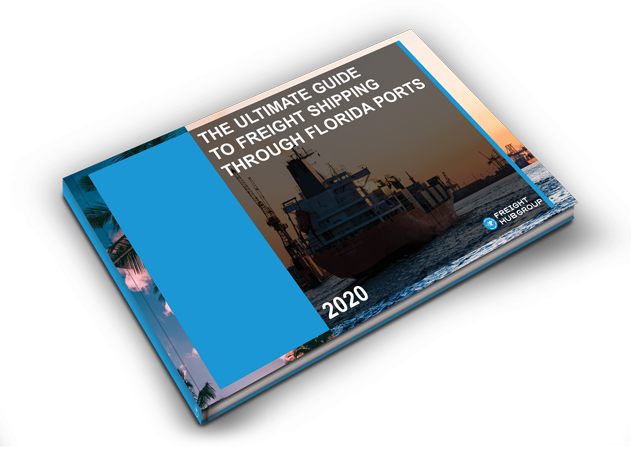
THE ULTIMATE GUIDE TO FREIGHT SHIPPING THROUGH FLORIDA PORTS
When it comes to ocean freight shipping in Florida, there is a lot to know to ensure you follow the appropriate steps when shipping into and out of Florida Ports.
Just enter in your email address and receive your FREE E-Book in minutes!