
How spot and contract truckload rates work for Florida shippers in 2026, why the state is a backhaul market, and how to build a blended routing guide.
Spot vs Contract Freight Rates: A Florida Shipper’s Guide for 2026
Every truckload shipper eventually asks the same question: should I lock in rates for the year or buy freight as I need it? The honest answer is that most shippers need both, in a deliberate mix, and the right mix depends more on your lane geography and volume consistency than on where the market happens to be this quarter.
Florida makes the question sharper. The state’s freight flows are structurally lopsided, and that shapes what a “good rate” even means here.
What spot and contract rates actually are
A contract rate is a price agreed in advance for a defined lane, usually through an annual or semi-annual bid (an RFP), typically held for a set term. In exchange for the price, the carrier commits to accepting a share of your tendered volume, and you commit to giving them the freight.
A spot rate is a price quoted for a specific load, right now, based on what capacity costs today. No commitment either direction.
The difference that matters is not the number. It is who absorbs the risk when the market moves. Under contract, the carrier eats the difference when spot rises above your rate — and pockets it when spot falls below. That asymmetry is the entire reason contract compliance breaks down in tight markets.
| Contract | Spot | |
|---|---|---|
| Price certainty | High for the term | None |
| Capacity certainty | Depends on carrier acceptance | Depends on the day |
| Best for | Consistent, forecastable volume | Irregular, surge, or new lanes |
| Admin effort | High up front (bid), low ongoing | Low up front, high ongoing |
| Risk in a tight market | Rejected tenders | Sharp price spikes |
| Risk in a loose market | Paying above market | Minimal |
How the truckload cycle works
Truckload is a commodity market with slow supply response, which is why it cycles rather than settles.
When freight demand outpaces available trucks, spot rates rise. Carriers begin rejecting contracted loads because the same truck earns more on the spot market. Tender rejection rate — the share of loads a carrier declines after you offer them — is the single most useful leading indicator of a tightening market, and you can measure it on your own freight without buying data.
Rising rates draw capacity in: owner-operators enter, fleets order trucks. Supply eventually overshoots demand, spot rates fall below contract, tender acceptance climbs toward the high nineties, and carriers hold contracts tightly because their alternative is worse. Then capacity exits and the cycle repeats.
Two practical takeaways. First, a contract rate is only as good as the acceptance behind it — a great rate a carrier rejects half the time is not a rate, it is a number in a spreadsheet. Second, the best time to bid is not when everyone else is bidding.
Why Florida is a different market
Florida is a structurally imbalanced, headhaul-in / backhaul-out market. Far more freight comes into the peninsula than leaves it — consumer goods, building materials, imports through PortMiami and Port Everglades feeding a large population with limited in-state manufacturing.
The consequences for pricing are direct:
- Inbound to Florida tends to price closer to market average, because trucks are competing to come in.
- Outbound from Florida carries a premium relative to distance, because carriers need to be paid to reposition and often deadhead part of the way. Georgia and the Carolinas are frequently the real destination on an “outbound Florida” truck.
- Intra-Florida is its own market. Miami to Jacksonville is a long haul inside one state, and the return leg is not guaranteed.
Two seasonal distortions layer on top:
Produce season. Florida’s winter and spring produce harvests pull refrigerated capacity into the state and then out at premium rates, tightening reefer availability broadly and spilling into dry van as shippers substitute. If you move temperature-sensitive freight, plan around it — refrigerated trucking capacity in South Florida is not evenly available across the calendar.
Hurricane season. June through November, with peak risk in late summer and early fall. Before a storm, retail and building-material freight surges inbound. During, ports and highways may close. After, relief and rebuilding freight can absorb regional capacity for weeks, and rates move sharply and unpredictably. Build slack into your commitments for this window rather than pretending it will not happen.
When spot beats contract, and vice versa
Lean spot when:
– Volume on the lane is under roughly one load a week, or highly irregular
– The lane is new and you do not yet have reliable volume history
– The market is loose and falling — locking a year at today’s number is locking in a premium
– The freight is project-based: a trade show, a store opening, a one-off heavy haul move
Lean contract when:
– Volume is steady and forecastable within a reasonable band
– The lane is capacity-constrained or requires specialized equipment
– Service failure has real downstream cost — production shutdown, retail chargebacks, a missed vessel cutoff
– The market is loose but you expect it to tighten during the term
Most shippers should blend. Put contracts on your top lanes by volume, where the carrier can actually build a network around your freight, and run everything else through a broker or 3PL on a transactional basis. Port drayage often sits outside this framework entirely, since container drayage pricing is driven by chassis availability, terminal congestion, and free-time clocks rather than long-haul capacity.
Building a blended routing guide
A routing guide is a documented, ranked list of who gets each lane and in what order.
- Segment lanes. Rank by annual volume. The top 20 percent by count usually carries most of your spend — those are your contract candidates.
- Name a primary. One carrier, one rate, one committed volume share.
- Name two or three backups at stepped rates. The rate should rise as you move down the list; that is normal and it is your insurance premium.
- Set a tender timer. Give the primary a defined window — commonly a few hours for next-day pickup — then auto-cascade.
- Define the spot fallback. When the guide is exhausted, who quotes it and what approval is needed? A broker or asset-based 3PL usually sits here.
- Review quarterly, not annually. Move volume away from carriers that reject, toward those that accept.
Small-lot freight belongs in a parallel guide. If a shipment is under about six to eight pallets, LTL is normally cheaper than a partial truckload — but check both, because on short Florida lanes with dense freight a full truckload can win on total cost once accessorials are included.
Metrics worth tracking
- Primary tender acceptance rate. Your early warning system for the market and for a carrier relationship going bad.
- Routing guide depth. How far down the list you go on average. Depth rising means your guide is failing.
- On-time pickup and on-time delivery, measured against the original appointment, not the revised one.
- Cost per mile and cost per load versus your contracted rate, so you can see what the guide failures actually cost.
- Accessorial spend as a share of total. If detention, layover, and reconsignment are climbing, the problem is usually in your facility, not the carrier’s.
- Claims ratio by carrier.
Mistakes shippers keep making
Bidding on lane averages. A lane priced on an average origin-destination pair ignores the specific facility. A dock with a two-hour average wait and no overnight parking is a different lane from a drop-yard operation ten miles away. Carriers price what they experience.
Ignoring accessorials in the comparison. Detention, layover, driver assist, liftgate, limited access, redelivery, chassis split, per-diem. A lower linehaul with loose accessorial terms routinely lands above a higher all-in rate.
No minimum volume commitment. If you award a lane without committing volume, you have no leverage when the market tightens. Carriers plan networks around promised freight. Give a realistic number and hit it.
Awarding on price alone. The cheapest bid on a lane is often a carrier who has not run it and will reject it in month three.
Treating spot as a failure. It is not. A well-run spot fallback is a designed part of the system.
Frequently asked questions
How often should Florida shippers rebid their truckload lanes?
Annual bids remain common, but many shippers now run smaller, more frequent bids — often semi-annual or rolling by lane group — because a twelve-month commitment can drift far from market in either direction. Whatever cadence you pick, review tender acceptance quarterly and reallocate volume between existing carriers without waiting for the next full bid.
Why are rates out of Florida higher than rates into Florida?
Florida receives substantially more freight than it ships out, so trucks that deliver into the state must either wait for an outbound load or drive empty to find one. Carriers price outbound moves to cover that repositioning cost. This is why an outbound lane can cost more than an inbound lane of similar length.
Should I use a broker for spot freight or go direct to carriers?
It depends on how much time you have. Going direct can work if you have a small carrier base on repeating lanes. For irregular freight, surge volume, or lanes where you lack relationships, a broker or asset-based 3PL sources capacity faster because they touch many carriers daily. An asset-based provider adds the option of using its own trucks when the market is tight.
Get a real number for your lanes
Averages will not tell you what your freight costs. Send us your actual lanes, volumes, and facility conditions and we will price them honestly, including where spot beats contract and where it does not. Request a freight quote or call (786) 445-0150 to talk with someone who runs South Florida trucks every day.
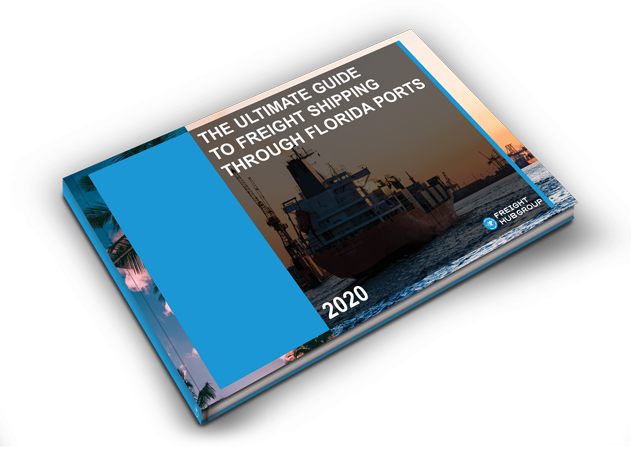
THE ULTIMATE GUIDE TO FREIGHT SHIPPING THROUGH FLORIDA PORTS
When it comes to ocean freight shipping in Florida, there is a lot to know to ensure you follow the appropriate steps when shipping into and out of Florida Ports.
Just enter in your email address and receive your FREE E-Book in minutes!